Title Explanation

When predicting the sex of an unborn baby, the Oracle of Delphi is said to have claimed that it would be a "Boy No Girl." She thus covered both outcomes, as one could interpret the statement as "Boy. No girl," if the child was born male or "Boy, no-- girl," if the child was born female. Living in Ethiopia, it's difficult to know my role. Am I a foreigner, a "ferengi," or am I a local, like the Habesha? Sometimes, I'm a little bit of both.

Rotating Banner

Showing posts with label Ethiopian Culture. Show all posts

Monday, November 18, 2013

PCV Profiles: Jenny in Haruta

I went to visit my fellow G7, Jenny in Haruta this September for an Ethiopian holiday called Meskel.  I talk about Meskel in my First Five Months blog post (I was really bad about blogging at the start of my service).  But to reiterate, "Meskel [is] the Orthodox Christian celebration of the discovery of the True Cross by Queen Elena.  Legend has it, she burned incense and followed the smoke to its location.  So the Orthodox Christians always have a large bonfire with a cross in the center to commemorate this miracle."

I did the whole town celebration in Hossana last year.  This year, I wanted something more intimate, so I joined my friend Jenny and celebrated with her compound family.  While I was there, I took some great video of her and how she lives with her family.  I compiled them into one fifteen-minute long video that wouldn't fit on YouTube, so I split them up into two videos instead on different aspects of my weekend visit with Jenny.  The first video I entitle "Compound Life," and depicts Jenny washing dishes and socializing with her compound family.  The second video is all about the traditional buna ceremony she prepared for her compound family.  Jenny tried to do it all herself, but found that her compound family couldn't just sit idly by and watch her do it wrong.

Let's watch, shall we?

Jenny in Haruta: Compound Life


Jenny in Haruta: Making Coffee


Thursday, November 14, 2013

Making Friends at Funeral Receptions


I had a long and productive day at the college on Wednesday, working through lunch and staying for our ELIC Clubs meeting where students learned about available clubs and signed up for the ones they wanted to take.  I spent most of my time pre-meeting developing a “unit plan” or curriculum for my culture club so I could give students a more detailed outline of what they would be learning about.

For the past two weeks, students have been coming to the ELIC (English Language Improvement Center) to sign up for English clubs.  We offer six: drama, debate, reading, creative writing, film and (as of this year, thanks to yours truly) world cultures.

I’ve taken to abbreviating the “World Cultures Club” to simply “Culture Club,” a club of my own design that uses the self-to-world approach to social studies learning by exploring first local and then international cultures.  Treating it as more of an optional class than a club, I’ve developed a curriculum in the form of a social studies unit of ten lessons, culminating in a final project where they research and present the culture of their choice (a culture different from their own).  I hope to turn this day into a sort of “International Fair,” maybe even have booths – but this may be a little too ambitious.  My counterpart does, at least, want me to have my students present their project to the whole college during English week, which may be more feasible than an all-out fair.  There are three super objectives for this club or course: the first is social studies/geography oriented, the second is English oriented, and the third is focused on research and citation skills.  Students will learn geography and cultural studies while practicing English in all four domains and building good research and citation habits.

I’ve posted fliers for the new club all over the school, which resulted in four students signing up for the club before the meeting.  During the meeting, I made it clear that I had high expectations, it would be a lot of work but a lot of fun, and at the end they’d get a nifty Hossana CTE certificate that was also *fingers crossed* signed by the Peace Corps Country Director (but I haven’t asked him yet – it might just be signed by me).  By the end of the meeting, seventeen students had signed up for the club, which officially begins on Monday with our first lesson: What is Culture?

Feeling pretty darn good about myself and my recruiting abilities (and ignoring the possibility that these students just signed up when they discovered that the ferenge was leading it), I packed up my things at 5:30 and got ready to get on the bus home.  Snug in my seat and preparing for the short walk home after my stop, I plugged in my headphones and started listening to the Stuff You Missed In History Class podcast and listened to the ladies talk about Archimedes’ Death Ray.  But then the bus turned around and I made a Scooby Doo-esque “Ruh?” sound.  The bus did a U-turn in the middle of the dirt road and started heading back to the college, then turned again down a dirt side street that led to the VSO Victoria’s old house (which now belongs to the new VSO at the hospital here).  We went down this road a bit when the bus stopped and everyone got off.  I turned off my podcast and dumbly followed like a sheep (which is what I always do when I have no idea what’s going on).

I caught up with a friendly face, a man I’d met last year named Hassen, and asked him what in the world was going on.  He explained that a colleague had just lost her mother, and it was expected “in our culture” that they go and pay their respects.

“But… Whose mother?”

He told me a name I didn’t recognize and promptly forgot.  I blinked stupidly, and wondered if this woman would even want me there, but followed the parade of colleagues up the road to her house.  When my landlord’s father died last year, he had invited me to stop by, but I felt uncomfortable about even doing that.  And I love my landlord!  I guess how we deal with grief is a cultural difference that’s difficult for me to adjust to.  In America, if an acquaintance loses someone, you might bring them a casserole, but you also don’t want to impose and you want to give them the space they need to grieve.  But your entire office coming over to your house and having you serve them tea, coffee and snacks just after you’ve lost a family member?  Well, if it were me, heaven forbid, I think that would be my worst nightmare.  The last thing I’d want to worry about is being a good hostess after losing someone close to me.

Still.  Ethiopia is a very communal culture.  They celebrate together, and they mourn together, as a community.  They call acquaintances “brother” or “sister” or if they’re older, “mother” or “father,” even though they don’t know them very well.  As Ethiopians are fond of telling me whenever I ask “Why?” about something they do, “It is just our culture.”  There is no why, it’s just how things are.

I was worried I would have to greet the grieving daughter, but I followed Hassen to a bench outside of the main house, where we sat and waited until the k’olo and chickpeas made their way over to us.  Hassen pretty much hoarded the whole plate and gobbled it down.  “You certainly like k’olo,” I said, and the other man with us must have gotten the joke because he laughed.  Hassen smiled at me, too.  “Yes,” he said with a shameless grin. “I do.”  Sarcasm, or any form of communication that relies on tone, are difficult to get across in this culture, but that one definitely landed.

We talked for a while, about all sorts of things.  I mentioned the age-old American tradition of bringing food to express condolences.  I tried to explain what a casserole was and now I think they believe it’s like lasagna.  Which, I added, people also give to mourners.  Casseroles, lasagna, and baked goods.  The staples of American cuisine.  Eventually I had to ask how long we were going to stay.  I was hoping that the bus would wait and take us all home again when we were done.  Hassen assured me it wouldn’t be longer than twenty minutes, and for once it was true.  After one cup of coffee and a few handfuls of k’olo, he told me it was time.  I never even saw the lady of the house, but I did play with the two toddlers bumbling around the compound.

I followed Hassen out of the compound and looked skeptically at the darkening sky.  Akin to Cinderella, or a reverse vampire, I am inclined to get home before sundown for fear of turning into a pumpkin, or dust, or, more accurately, running into a hyena.  Now, that seemed impossible.  This wasn’t as serious as it would be for Cinderella or vampires though.  I’ve walked home at night in the past, I could do it again, I just prefer to avoid it when I can.  And anyway, Hassen walked with me.  At first, towards the bus, but then he backtracked and told me to go the opposite direction instead.  That’s when I realized my hope of catching the bus home was dashed.  But Hassen was with me, so at least I had company.

We continued talking, about many things.  A few kids yelled some things at me as usual, and I complained about it.  He said it’s because they don’t understand, and I resisted the urge to say “Tell me something I don’t know.”  That led me to talking about my culture club, and how cultural ignorance was one reason I had created it.  Hassen was fascinated.  He’s a history teacher, that’s his specialty you see, and so he wanted to hear all about my club.  I told him about how I had opened up a book during the meeting today.  It was a book called “America 24/7” and was given to me by USAID (I think).  I got a whole bunch of them.  Nathan says that they couldn’t have given him a more useless or propaganda-filled book, but with my culture club I may have found a place for them.  I had opened up a page at random and showed them, and it just happened to be a photo of a cowboy.  I had laughed at the time, because I had been trying to show them a less stereotypical photo of American life, but that was the one I had randomly turned to.  I asked if he knew what a cowboy was, and he laughed and said he did.

“In Ethiopia,” Hassen explained, “we think there is no rural land in America.  We think it is covered in big cities only.”

“If we were just big cities,” I returned, “there’d be no room for the cowboys.”

I talked about how the majority of the US was actually rural, the same as most other countries in the world.  I talked about our spacious skies and amber waves of grain.  Not in those words, though.  I explained that was another reason I’d started this club.  I wanted to share my culture with them, but also have them share their cultures with each other.  Even within Ethiopia, there are some grave misunderstandings about people from other zones and regions.  Hassen agreed with me that culture sharing was the best way of building empathy and tolerance towards people who are different.

He invited me for coffee.  The sun was just about gone now, so I was definitely going to get home after dark now.  I agreed, and impressed him with my bunabet (coffee house) Amharic skills, asking for “t’ena adem” (Adam’s Health) in my coffee.

“You drink buna ba t’ena adem?” Hassen asked, chortling.

“It is my favorite,” I said.

T’ena adem is a plant known in the English-speaking world as “rue.”  It’s the same plant that the character of Rue in the Hunger Games was named for.  In Ethiopia, they grow it as a potted plant, then pluck off a sprig of it and add it to the coffee in the same way we might add a sprig of mint to our tea, or a cinnamon stick to our cider.  It adds a unique flavor to the coffee that I can’t describe but is so delicious that I am definitely growing my own rue plant when I get back home.

We  talked some more about American history, about which Hassen was surprisingly knowledgeable.  I suppose I shouldn’t be surprised.  He is, after all, a history teacher.  When I mentioned the thirteen original colonies, he said, “I actually have a list of them in my briefcase.  I could name them all, if you like.”  Laughing, I told him that wouldn’t be necessary.

He enthused some more about my culture club.  He asked if he could participate and I delightfully said, “Of course!” I told him that if he liked it enough, maybe he could continue the club next year in my absence, in partnership with the next Peace Corps Volunteer and he liked that thought as well.

He walked me almost all the way home, so I didn’t have to worry about hyenas.  It was a long, strange day, but it ended with me feeling optimistic about starting a brand new club.

Thursday, October 24, 2013

Converstions with an Ethiopian Living in Seattle


Today, I was lucky enough to meet a relative of my friend Belay.  Abera was pre-introduced to me by Belay over a lunch meeting concerning a reading program I will be doing at his school this year.

“You’re from Washington State, right?” he asked, sipping his Mirinda when all work talk was finished.

“Yes,” I said, then quickly added, “Not to be confused with Washington DC.  They’re on opposite sides of the country.”

Belay, who’s quick on the uptake and highly educated, smiled. “Of course,” he said. “What city?”

“Seattle,” I replied.

He smirked in that smug way a student does when he gets the right answer. “I knew it,” he said, and proceeded to tell me about his brother Abera, who was really his mother’s brother, but they were close enough in age that their relationship was more that of brothers than uncle and nephew.  Ethiopians have a habit of calling almost anyone in their family brother or sister, regardless of the actual blood relation.

Abera happened to be visiting Hossana from, of all places, Seattle, where he has made his home just off of Aurora for the last five years.  I met with him briefly yesterday, when he joined Belay for dinner and I headed home.  But I sat down and had lunch with both of them today, a lunch that lasted four hours full of fascinating conversation.

It was strange speaking to an Ethiopian about Seattle neighborhoods.  He asked where I lived, and I said Green Lake, and tentatively asked, “Do you know it?” His response was to laugh and tell me about his place just off of Aurora.  Of course he knew Green Lake.  He lived there.  So I got more specific.  “Off Phiney Ridge.  That’s where.” He nodded.  He knew exactly the neighborhood.

Belay asked if there was anywhere in Seattle to get Ethiopian food.  I began talking about Habesha restaurant which was, as I described it, “Down town near the pink elephant, I forget which street.”

But Abera was on the ball. “It’s on Olive,” he told me, and I smiled, impressed he knew downtown better than I did.  But then he added, “But it’s closed now.  Gambling problem.”

“Oh no!” I said. “Where will I go for Ethiopian now?”

“There is a place,” he explained, “Lucy’s Restaurant.  On Aurora and 100th.  It is the best.  I invite you when you come home, and we will go.”  Because despite living in America for five years, Abera was still one hundred percent Ethiopian and proud, and he spoke like it, too.

“Did you know,” Abera told me seriously, “that there are fifty-four thousand Ethiopians living in Seattle?”

“I knew there was a large community, but I didn’t know it was that large,” I confessed. “How do you know that number?”

“There’s a community center of Rainier Avenue,” he told me. “They keep track of the population.  It is growing.”

So I decided to ask Abera something that has been plaguing me ever since I realized that there are some pleasures in Ethiopia that I’d have to give up when I moved back home.  I prefaced the question by explaining that it was very serious, and I was very concerned about it, and I hoped that he, as an Ethiopian who knew Seattle well, could answer it for me.  So his face grew very serious and he nodded, ready to take on this responsibility of finding an answer to my question.

“So here it goes,” I said, holding my breath. “Is it possible to get shakala tibs anywhere in Seattle?”

Shakala tibs, for those not familiar with Ethiopian cuisine, is a meat dish that is served on a small, coal-burning stove with the meat still cooking and mixed with peppers, onions and spices.  The only equivalent I can help you think of is steak fajitas, but at the same time it’s completely different but just as delicious.

He burst out laughing. “This is your question?”

“Yes!  It’s very serious, I love shakala tibs and I don’t think Habesha had it on the menu!”

Still laughing, he nodded. “There is a place.  Best place in all of Seattle.  I will show you.  I invite you.”

I breathed a huge sigh of relief.  Shakala tibs was the one thing I was going to have a hard time giving up.  To hear that it was available in my home town reassured me greatly.  So I asked him if a few other things were available.

“Can you get k’olo?”

“Yes.”

“How about shiro?”

“Yes, but shiro and berberi are both expensive in Seattle.”

“Berberi?!  I can get berberi?”

“Of course!”

He stopped my questioning by telling me that practically anything that I could get in Ethiopia, I could find in Seattle.  Every time I used an Amharic word, he laughed, loving every minute of it.  He loved that he had found a white woman from Seattle who knew enough about his country and culture that she could use its words correctly and name cultural practices like they were her own.

“In Ethiopian culture, it is common to feed your friend,” Abera explained, in the tones I’m sure he used when he was trying to explain it to local Seattleites.  “We take some food, and we put it in our friend’s mouth to show that we care and we love each other.”

“Of course,” I said, as he wasn’t telling me anything I didn’t already know.  “I get gorsha’d all the time.”

“Gorsha!” he repeated, his eyes and smile wide.  “Gorsha, she knows gorsha!” he told Belay, as if Belay should be surprised as well.

“She lives here,” Belay reminded him, an amused look on his face. “She knows everything about Ethiopian culture.”

“She does,” Abera agreed approvingly.

I think he was as surprised and interested to meet me as I was to meet him.  It was strange and reassuring to speak with an Ethiopian who is not only familiar with American culture, but also my home town.  Our conversation revolved around cultural differences, and despite having lived there for five years, there were some things about American and Seattle culture he didn’t understand.

“When you smile in Ethiopia,” he explained, “it means that it is OK to talk and be friendly.  But people, they smile all the time in America and when I try and talk to them the smile goes away and they are unfriendly.  Why is this?”

I laughed because I knew the exact attitude that he was talking about, the American polite-but-not-too-friendly approach to everyday interactions with strangers.  This segued nicely into a conversation about the infamous Seattle Freeze, and once I described the phenomenon to him, his jaw dropped.

“Yes!” he cried. “Yes, I see this all the time!”

“It’s not just you,” I assured him. “It’s confusing for other Americans, too.  We like sending mixed messages.”

We talked about the concept of “personal space,” and how deeply Americans love theirs, whereas the concept is nonexistent in Ethiopia.  We talked about how Ethiopia is a collective culture, all about the group, and everyone is family, and we share everything – whereas America is an individualistic culture, and you earn what you have, and you win or lose on your own merit.  We talked about the pros and cons of each.  We talked about how America is over polite – saying “excuse me” and “sorry, sorry!” for simply touching someone on the bus, whereas Ethiopia is not polite at all.  They seemed to like my metaphor of America being too much sugar in coffee, whereas Ethiopia had none.

“Which is better, do you think?” Abera asked.

“Well, I don’t think either is better,” I said.

“I think they are examples of two extremes,” Belay said wisely.  “I think it’s better to be in the middle.”

“What he said,” I said.

We talked about how the West could do well to learn a little bit from Non-Western cultures as much as if not more so than the other way around.  We talked about Westernization in general, Malala and her message of education, education as universal value versus a Western value.  We talked about American churches and Ethiopian churches, and their differences and similarities.  We talked about poverty, and the definition of poverty, both in an Ethiopian context and an American context.

“You know those homeless people on the side of the road?” I asked Abera, who just rocked his head back and forth in a deep nod.

“Homeless, what does this mean, homeless?” Belay asked.

“It is someone who does not have a house to live in, so they sleep outside,” I explained. “Many are also very poor.  People like to tell them to get a job, but they don’t understand how difficult that is if you have no phone or address.  A bit like the beggars on the streets, here in Hossana.”

Belay looked shocked. “But this is not common in America, surely.  It is a rare thing, yes?”

“Actually, it’s more common than Americans like to admit,” I said, looking to Abera for confirmation who continued his deep nod of understanding.

“Yes,” he agreed. “Very common.”

“This sounds to me like the government should take care of these people,” Belay said.

I smiled.  Out of the mouths of non-Americans… “Well, there are homeless shelters and soup kitchens.  Buildings that the government sets up to give somewhere for the homeless to sleep and get some food.  But shelters get crowded.  Soup runs out.  Some volunteers and good people do other things to help.  Most pretend that they don’t exist.”

I very quickly discovered that one reason Abera was so good at naming all the streets in Seattle was because he was part of the popular town car and taxi industry.  He had two town cars as well as a cab that he drove all over the city to make the big bucks.  So he shared with me some insight not just what it was like to be Ethiopian in the strange American culture, but also what it was like to be a cab driver.

“In Ethiopia, we like to talk,” he said, “and taxi drivers, many of us like to talk, too.  But the customers, sometimes they don’t like to talk.  So you have to be careful.  Sometimes if you ask one question, they get angry.  ‘Why are you asking me?’ they say. ‘This is not your job, you just drive me where I want to go!’  ‘OK!’ I say.  I do not mean to upset them.”

And then, the conversation took a turn.

“Do you see drunk people, here in Hossana?”

“Yes,” I said, a little uneasily. “They come out at night.”

“Of course!  Only at night,” he said with a laugh. “What do you think of them?  What do you do?”

“I don’t go out at night, for one.”

He laughed again. “Which is worse, drunk people in America, or drunk people in Ethiopia?”

“Um…” I began, not sure where he was going with this.

He saved me from having to answer.  “As a taxi driver, Friday and Saturday nights are the craziest.  I see a lot of drunk people at night.  There are many kinds.  There is the drunk who falls asleep in the back seat.  There is the drunk who will not give me the address because he ‘knows where he is going,’ and wants to direct me even though he barely knows where he is.  There is even the ones who throw up in my car.  But even these are not so bad as others.”

He proceeded to tell me about something that I knew happened once in a while to cab drivers, but I had no idea was so common.  He talked about drunks, and even sober people who were just jerks and belligerent, who would refuse to pay because they claimed not to have any money.  He explained how dispatch always advises them not to escalate the situation.  If someone doesn’t want to pay, let them go, because you never know what could happen if you push the issue.  He told me a story about his friend, who drove one fare home.  The guy got out of the cab, pulled a gun, and held it to the driver’s throat before saying that he didn’t have any money to pay him and to just be cool with it.  The driver obviously let it go, said it was no problem.

“Why?!” Abera asked me, as if I had the answer. “If you can’t pay, fine, say that, we won’t do anything, you do not need to bring the gun out first!”

He talked about his own fare, a well-dressed middle-aged sober individual who seemed respectable and mild mannered enough.  When he dropped the fare off at his apartment, the man said that his money was upstairs and that he would be two minutes, and to trust him, he’d be right back.  He showed Abera his wallet to prove he had no money.  And so Abera let him go, even though he knew he wasn’t coming back.  And he waited.  Five minutes.  Ten minutes.  Fifteen.  Finally, he called his dispatch and asked for advice, and was told what they always say.  “Sixty dollars isn’t worth it.  You don’t know what he’s capable of.  Just go get a new fare.”

“You should have taken his wallet,” I said. “Make sure he comes back.  We call that collateral.”

“I should have,” Abera agreed. “Maybe next time.”

“If that happens to me, I always leave something behind, so they know I must come back,” I explained.  I told him about how one time I realized I’d forgotten my wallet at home after eating at a café.  I handed the waitress my phone and insisted I’d be back to claim it.

“And hey, if I was lying and never came back,” I said, “she could have always sold my phone instead.”

Abera’s tales nurtured in me a newfound sympathy for cab drivers and all the stuff that they have to go through.  I didn’t realize that people who refused to pay were, more often than not, just let off the hook with a free ride.  It made me want to ask my next cab driver if he’d been stiffed for a fare that day, and if he had, to cover whatever the charges were on behalf of my fellow (yet horrible) human beings.

A lot of cab drivers need that money probably more than you do.  If you call for a cab, you’re asking for a service that’s not free.  Please don’t take advantage of cab drivers.  They have a dangerous job, and they earned their pay, so give it to them and respect them.  I won’t even say anything about tipping, just give them what is owed.

Like most in the business, Abera doesn’t want to be a cab driver his whole life.  He’s working on gaining his citizenship, and wants to eventually enroll at the University of Washington to change his career path.  He has two bachelors from the University of Addis Ababa, but that’s pretty much meaningless in the States, so he wants one from my alma mater.

“Is a good school,” he said, when I told him I was a graduate.  “I hope I can go there one day.”

Abera offered to help me reintegrate back into American society when I go home in a year.  He promised to introduce me to his friends and the Ethiopian community there with which he is involved.  He told me he would show me the very best places in town to get Ethiopian food, and that we can definitely get some shakala tibs.

It was refreshing to meet an Ethiopian who got what life was like in the United States.  One who had lived there long enough to understand that it wasn’t all sunshine and roses, who can appreciate both the good and bad things about it, but also keep his unique national identity.  I have lived in Hossana for a year, and yet I have met no one prouder to be Ethiopian than Abera.  He said he liked to brag about it when he talked about Ethiopia to Americans.  How ancient his country is, how historical, how diverse and beautiful.  I told him that he should be proud, and I was glad he appreciated it so much.  “There is no other country like Ethiopia,” he told me, and I agreed wholeheartedly.  His pride stirred my pride, too.  I’m proud of Ethiopia, I’m proud to live here and call it home for a part of my life.  I felt as blessed to meet someone who knew both cultures so well, and I’m pretty sure he felt the same about me.

After all, it’s not often that he gets to talk to a white American girl in Amharic.  And it’s not often I get to talk to an Ethiopian about the Seattle Freeze.

Sunday, August 18, 2013

Life in Hossana - an Update

The power went out across town yesterday.  This, in and of itself, is not so unusual for Ethiopia.  However, the power went out for eight hours, came back on briefly for an hour, then went out again until about midnight (I know this because I'd accidentally left my light switched "on" and it woke me up).  This is unusual for Hossana, a big and bustling town that's spoiled as far as power and (as of last year) water are concerned.

I was supposed to be working on session plans and powerpoints for the trainings I'm doing during PST up in Butajira this week.  I was supposed to email those to our PCVL.  But the power was out and my computer died, so what can you do?  The good news is, I got all of that done today.  I'm uploading attachments to my email to our PCVL even as I type this.

It's unusual for me to not have power for any long stretch of time.  As such, I've never really had to entertain myself when I can't do work and/or use my laptop for fun things like watching TV or computer games.  I puttered around a bit.  Rearranged some stuff, cleaned my house.  And I saw how beautiful it was outside.  When my site mate, Christina, COSed, she sold me some of her furniture.  Because I was out of the country when she flew home, I had my landlord let her in and bring the furniture.  It's nice because I didn't actually have to move anything myself.  Also, Christina's couch and matching arm chair that she left me are super comfy.  I'd been using the chair as a dumping ground for all my things when I get in the door.  My purse, jacket, grocery bags of toilet paper, and other odds and ends were piled in the seat.  I cleaned them all off, and took the arm chair out onto my porch with a book I was in the middle of reading (The Mysterious Benedict Society, for those of you who are interested).  I also brought out some dried mangos and some apple juice I'd bought at my ferenge suk to snack on while I read in the sun.

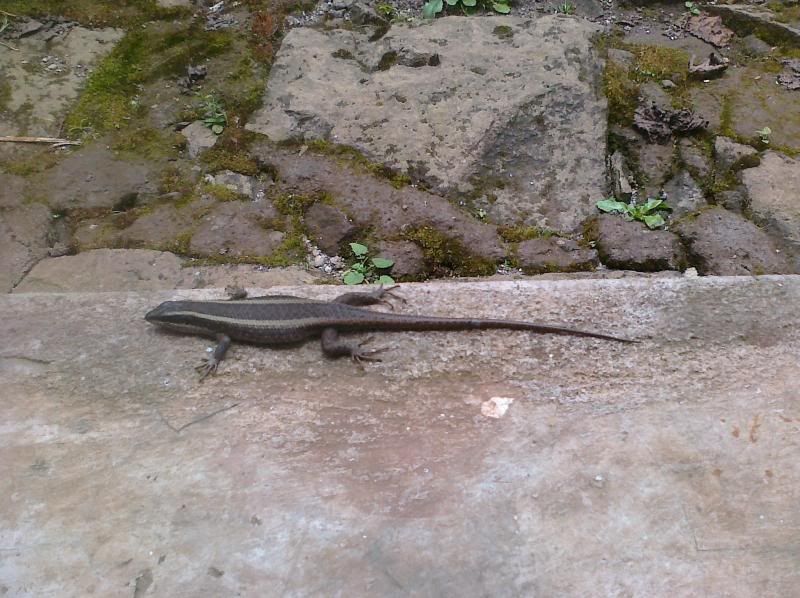
I wasn't the only one enjoying the sun that day.  Hossana is home to a particular breed of small lizard that I have yet to identify.  I've always wanted to snap a photo of one of these lizards, but the problem is they dart away so fast it's impossible.  And, unlike geckos, they mostly keep out of sight and don't come into my house, so I only see them when they're racing from point A to point B across my path.  But not today.  Probably because it's in the middle of rainy season, these lizards need all the heat they can get.  So there was one on my porch, just chilling in a patch of sunlight as he soaked in the rays.  He was enjoying it so much, he allowed me to get stupid close to him and snap a photo on my old Palm Pre Plus - a two-year-old now defunct Smart Phone that I use to listen to podcasts and reread old text messages.  My phone has no zoom on it, so you can imagine how close I had to get to get the image you see here.


But that wasn't all my lizard action today (boy does that sound weird out of context).  My friend zoomed off, as lizards here do, onto what I refer to as the "patio area" of my yard.  It's really the old concrete foundation of a shed that my landlord knocked down not long after I arrived here last year.  Now, he's erected some sort of lattice work above the concrete to support a growing grape vine.  Anyways, as I followed my little friend out onto the patio, I saw him meet up with another, smaller lizard.  I don't know if the lizards were mates or not, but they didn't seem particularly perturbed by each other.  I watched them dine on a line of ants that were marching across the patio before they both scattered in other directions.  I took a short video of these two on my old phone, too.


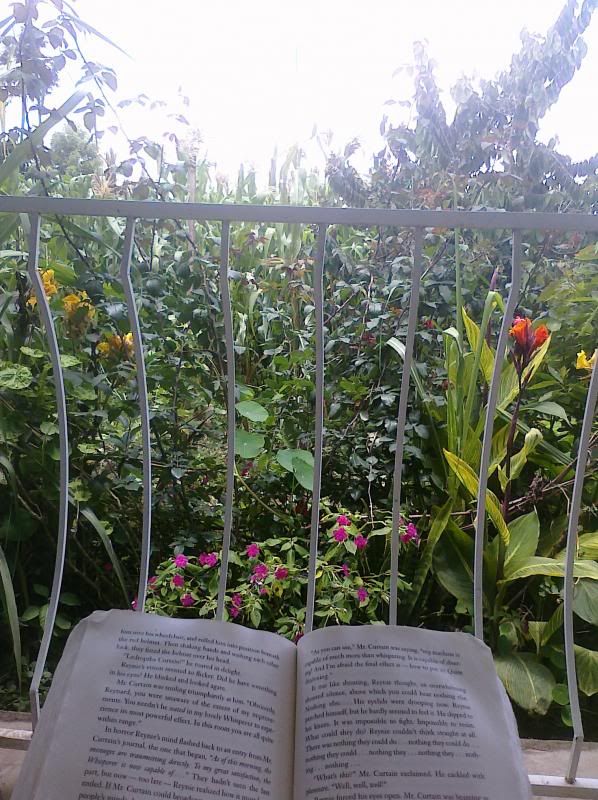
Above is a photo of the view of my garden from my perch on my porch as I read my book.  It was so enjoyable just sitting out there and reading that I finished my book and began a new one on my refurbished Nook.  (Side note: I'm a little concerned about B&N's product.  This is my third one under an extended warranty, and though the first two had two completely different problems, they have the fact that it was caused by factors beyond my control in common - glitches hidden somewhere in the factory-installed software that messed up the programming, and I had only put legitimately purchased B&N Nook books on there, so I can't be accused of giving it viruses or anything.  At any rate, I hope third time's the charm and my Nook Simple Touch lasts, but if it doesn't, I'm writing a strongly worded review about this useful but entirely buggy product).  The new book I'm reading now - and halfway through already thanks to the blackout - is Ender's Game, which, yes, I've already read, but that was ten years ago now, and with the movie coming out, I need to refresh my memory.

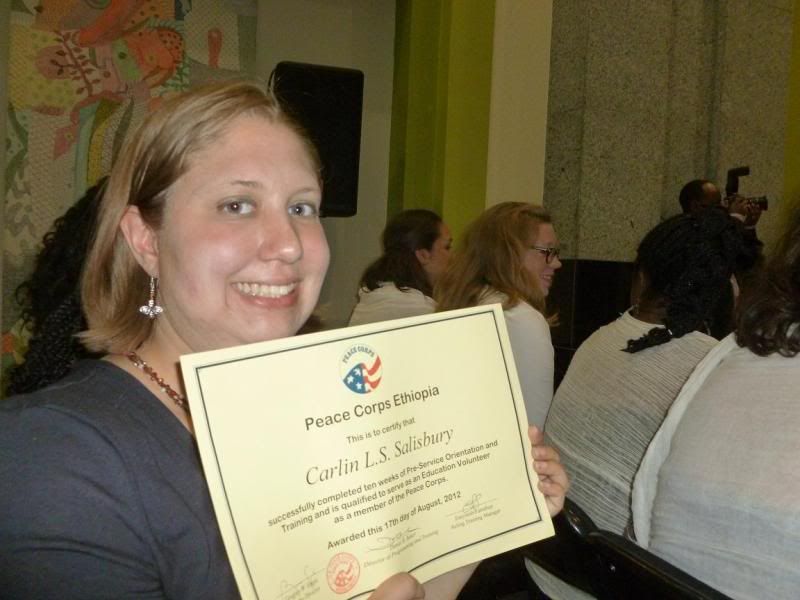
In short, yesterday was the perfect way to mark my Peace Corps-versary.  Yes, that's right. On August 17, 2012, I was officially sworn in as a Peace Corps Volunteer in Ethiopia.  So what better way to celebrate than by going with the flow of no power and spending the day reading on my porch, smelling the flowers, watching the wildlife, instead of cursing the gods and complaining about how I can't get work done or watch my stories?  I must be growing up.

Carlin, August 17, 2012, Addis Ababa
Carlin, August 10, 2013, Ziway
Look how far I've come.  And when I say that, what I really mean is, look how long my hair has gotten!

I've also been making soups from scratch.  It's easy and delicious, and filling if you add enough thickener, rice and/or noodles to it.  Every time, the soup tastes different, because I'm always adding to it, but it's always delicious.  It's perfect for the rainy days that this season brings, and nice to curl up with and eat while I read my book on my new couch, or maybe watch an episode of Community on my laptop (if there's power).  I've included the recipe, with common substitutions below, just in case any of my friends want to know what the new staple of my diet tastes like.  It's a variation on the egg drop soup of the PCV Ethiopia Cookbook.  Which, by the way, if you want a creative cookbook with fun recipes and explanations on how to easily make Ethiopian and American food, shoot me an email and I'll be happy to forward you the PDF.  But there are two version of the egg drop soup in the cookbook.  Mine sort of combines both the recipes.  Here it is.

Ingredients 

4 cups of broth or stock (chicken, beef, or vegetable - dealer's choice)
2-3 skinned and sliced carrots
2-3 small onions, diced (in America, just use one big whole onion)
1 clove of garlic
1 tsp Ginger powder, or grated ginger root
1 tbsp of honey
1/4 cup of cold water
1 spoonful of corn flour
2 eggs
Black Cajun Seasoning (to taste)
Curry powder (to taste)
OPTIONAL: Noodles or rice

Substitution note: If you don't have stock cubes for broth, you can use seasoning from Ramen packs.  Perfect, if you're also using Ramen noodles.

Put the broth on to boil.  While that's heating up, dice your onions and garlic and slice your carrots and add to the soup.  Add ginger and honey, and seasonings to taste.  Meanwhile, in a separate bowl, combine the 1/4 cold water with corn flour and mix thoroughly until it is a milky liquid.  In another bowl, beat your two eggs.  Bring broth to a boil.  Add noodles and boil with broth for as long as noodle packet advices (note: if adding Ramen noodles, only boil 2 minutes, but spaghetti is normally about 8 minutes).  If not adding noodles, just consider how well cooked you want the carrots to be, although I've boiled for 8 minutes with carrots and noodles and it seems to turn out OK.  Slowly add corn flour mixture.  Be careful, as the flour will settle so mix it again if it does.  Remove from heat.  Add beaten eggs and mix them into the soup.  Soup should change color and texture with the eggs.  Serve while piping hot.

So that's been my hearty and tasty meal of the month, and as mentioned, it's perfect for the weather here right now.  And with autumn right around the corner for you fine folks in the States, I'll bet it'll be great for those chilly nights.  I've been thinking of trying to explore and create a Hossana spin-off of the recipes in the cook book every month.  My goal is to include a new "Peace Corps Carlin" recipe in this blog each month, to give you guys a little "taste" (haha) of my life here.

Anyways, I hope you enjoy my personal version of the egg drop soup.  Don't let the onions get to you too much (I am terrible at chopping onions, and have to take frequent breaks, but they're so delicious in the soup!)

Signing off for now (photos - and maybe even video of the lizards - to come in an update later this week, so watch this space!)

Carlin

Friday, January 18, 2013

First Three Months At Site

JANUARY PREFACE: I managed to salvage this much from the wreckage of my hard drive of my original "Three Month" entry, which was drafted in October, when Jackie was visiting.  For a more concise version of my first four months at site, please see  this entry here.  I am posting this for a more expanded view of August and September.  I had written October as well, but lost that when I lost my computer.

---

So I have learned a lot about myself in these first three months.  Namely, that while I had absolutely no problem updating the world on every mundane detail of my teenage life, for some reason I seem incapable of updating a blog about moderately interesting things on a regular basis.  But I felt in a big update mood today, so as I write this I am also uploading a couple hundred photos to Facebook, taking advantage of my free wireless.  We'll see how many actually get posted.

I am going to reflect on my first three months here month by month:

August

I arrived in Hossana on August 17th, where I road down with several PCVs in my group, most notably Jackie, who is my nearest site neighbor (and bringing me pumpkin bread!  But we'll get to that when I get to October).  My goal was to take a week to relax and get some things in my house together before jumping in with both feet the following Monday and going to the college every day, if only so I could be seen every day by the folks at the college.  My counterpart, Elfineh, advised me against this, because summer school was still going on.  So he told me to wait until the next school year started up, and I took his advice.  I spent the rest of the month ordering and obtaining furniture for my room.  All the furniture I have now, I got in my first few weeks.  And "all" the furniture includes a bed, complete with mattress, and a cabinet.

The first impression I had of my house was one of surprise and relief.  On the way down to Hossana from Addis, we dropped off several PCVs along the way, and I got to see their living quarters.  I'd also seen living quarters for PCVs when I visited Kemise, and the compound where I lived in Bekoji is also what a PCV can expect.  In fact, there's a PCV from my group currently living on my compound, with my host family as his landlord family.  Yeah, I'm kinda jealous, because I love them so much, but it's also nice to be here.  Also why it's nice to be here?  My house is beautiful.  Most PCVs have one room, maybe two if they are lucky, unless they are married.  They'll probably have a shared shintebet and a showerbet that's basically a concrete room to splash around in.  I have three rooms, plus a private porch with a beautiful vegetable garden, and a private shintebet.  I also have a showerbet with an actual shower in it, hooked up to the pipes.  Of course, upon arrival, there was no water in the pipes at all, but hey, it was rainy season, and I was used to bucket bathing after living in Bekoji for two and a half months.  I got by just fine.

There was one minor problem.  There was a beehive on my front porch.  Filled with honest-to-God bees.  After typing about this story for a while, I've decided it warrants its own blog post.  So I'll tell you the tale of the bees and what became of them (and me) in a follow-up to be posted very soon (I promise!)

September

In early September, I had my site mate Deanna help me hang my mosquito net over my bed.  In reality, she did most of the hanging, and I did most of the delegating.  When I went to sleep that night and tried to close the curtains over my windows/door, I realized a problem.  Deanna and I had placed the nail holding my net up right in the path of the curtain, so I couldn't close it all the way.  Never one to do anything by myself (even when I am perfectly capable) I had my landlord fix it with a hammer the next day by moving it to the center where the curtains met.  And now, I'm protected from mosquitoes, and I can close my curtains.  Happy day!

September 11th is Ethiopia's equivalent of January 1st.  So I celebrated the New Year at my site mate, Christina's compound.  Christina wasn't actually there, but Deanna and I spent time with her landlord family.  Dorowat is the traditional meal of choice on Ethiopian New Year, so I ate a lot of that.  It's basically chicken in a red sauce with berbere that you eat (like everything else) with injera.  The next day, I went over to Deanna's house with my new egg boiler and made deviled eggs.  It was my first taste of legitimate Americana in Ethiopia and it was delicious. She also made this peanut sauce that we had over rice - also delicious.  The next day, Elfineh invited me over and I had more dorowat.  He said he didn't invite me for the new year because he thought I was in Addis.  I don't know why he was under that impression, but I didn't ask.  We talked a lot about all sorts of things, particularly current events which, at the time, revolved around the attack on the American embassy in Libya and the protests and riots across Muslim countries.  I've noticed Ethiopians like to talk international politics and news with ferenge, and they keep asking me when we'll know if Obama is president again.

Life moved on for the most part (excluding the bee situation, which you'll hear about later) until September 27th, which is the Ethiopian Orthodox Christian celebration of Meskel, particularly big where I am in the Southern Nations.  Meskel is the celebration of the discovery of the True Cross by Queen Eleni.  Legend has it that she was told how to find the cross in a dream, and that the smoke from a great fire would tell her.  So they built this massive bonfire with frankincense and wood and stuff, and the smoke blew in the direction of where the cross was buried, and supposedly touched down right on top of it.  Queen Eleni ordered her people to dig and discovered this holy artifact.  To commemorate this moment, every year Ethiopians have massive bonfires and dance around them and eat a lot of food.  Good times had by all.

Unless by "all" you mean Carlin, in which case, no, Meskel night was not a great celebration for me.  I mean, I had an awesome time and all watching the ceremony and got some great photos that you can find on my Facebook.  I'd like to share photos here, but they'll have to be edited in later.  Interwebz is misbehaving.  Anyway, the ceremony itself was fantastic, but I must not have drank a lot of water that day, or maybe my blood sugar was low, or maybe the temperature changes from hot day to cool evening to hot fire to cool night were just too much for my body to handle.  I tried to revive myself in a cafe with a soda and water (to cover all my bases), but drinking these things just made me feel worse.  Inevitably, I told Deanna I was going home.  She was going to walk with me, so I stood up, turned around, and collapsed in the middle of the cafe.  Apparently, I fell right on some Habesha man's lap and freaked him out before hitting the floor.  I woke up a few seconds later, completely confused.  I sat down and recovered while Deanna called her then-boyfriend to take me home in his car.  After I got home, I felt much better, but that's the first time I've actually fainted in my life.  I have almost fainted before, been on the verge of it and everything, but never actually done it.  It was exciting times indeed, that Meskel.

October

[Missing...]


Hossana - The First Five Months

So I guess I am awful at blogging.  Thankfully, most of you follow me on Facebook and notice my small triumphs as status updates.

This blog entry was initially titled "The First Three Months At Site" back when I was drafting it in November.  And then, my computer did a face plant on the concrete and I lost the (at the time, unsaved) word document with the very long update, which detailed, month by month from August through October, my exploits.  Here, you will find the short version of that in bullet points, plus two extra months (December and January).  December was so eventful, it's possible it will warrant its own post.

Highlights From August
  • For the first few weeks, I slept in my sleeping bag on a mattress on the floor.  This month involved adjusting to life in town and figuring things out at my house.
  • I ordered a bed frame for my mattress and a cabinet to store some stuff, mostly food.  To this day, this is all the furniture I have in my house, excluding some plastic chairs.
  • I wandered aimlessly, wondering what to do.
  • I battled spiders and other creepy crawlies in my mattress bed which brings me to my last and most important point about August -
  • The bees.  My house, beautiful and big as it is, had one tiny flaw.  Or rather, hundreds of tiny flaws.  Bees.  There was a domesticated beehive perched on my front porch that my landlord was using to make honey.  This was all well and good, and I didn't think it would be a problem, until for some reason the bees found their way into my house every time the light was on at night.  My temporary solution?  Don't turn on my lights at night.
  • On August 26th, my landlord came over to check on the bees, shining a flashlight directly in the hive.  Because he is good-natured and he wanted me to feel included, he asked me to look at all the honey he was going to get.  I obliged, stepping out on my porch, leaving my door ajar.  This was a bad idea.  Because he had awoken the bees at night, they were all up and buzzing - and swarming to the light in my house, which I had turned on to see where I was going before I went outside.  This is the second time this has happened, but it's significant because this time, I tried to rid them myself.  Before, my landlord helped.  This was a bad idea.  A bee got caught in my hair.  I ran around like a chicken with my head cut off batting at it.  This was also a bad idea.  So I got stung in the scalp, and my landlord, a nurse, spent a good ten minutes digging out the stinger for me.  This was the day I put my foot down and told him to move the bees.

Welcome to Hossana!

 photo P1010804_zpsa9dda1d3.jpg

Highlights from September
  • September in Ethiopia is kind of like December in the United States and Europe.  There are two big cultural celebrations, one of which is the end of the old year and the beginning of the new one.
  • September 11th, the Ethiopian New Year, saw me at my site mate, Christina's house with her landlord's family eating dorowot.  Wonderful, but uneventful.
  • I finally got the furniture I ordered.  My bed and cabinet are set up.  A few weeks later, my site mate, Deanna, helped me hang my mosquito net.  Goodbye, creepy crawlies in my bed!  (For the most part)
  • September 27th marked Meskel, the Orthodox Christian celebration of the discovery of the True Cross by Queen Elena.  Legend has it, she burned incense and followed the smoke to its location.  So the Orthodox Christians always have a large bonfire with a cross in the center to commemorate this miracle.  I had fun, watching the celebration where the market generally was.  Although, all in all, it wasn't a good day for me.  I was feeling dizzy, either from low blood sugar or dehydration or both, but when I tried to hydrate with water and a soda, it didn't go so well.  Deanna was taking me home in her then boyfriend's car.  I stood up, turned around and passed out, right in the lap of another diner, who was horrified!  It was my first time fainting ever, so it should be commemorated.
  • Meskel was also the day I met the new VSO volunteer at the college in our town, Victoria.  What a crazy first impression I must have made! 


Here is a photo from Meskel. Note the preparation for the giant bonfire later. The choir is in the background, and this holy man seems to be leading the service.

 photo P1010767_zpsbe2646e6.jpg

Highlights from October
  • The eighth group of Peace Corps Volunteers since the program reopened in 2007 arrived in the first week of October.  G8, as they are known, are a combination group of health and environment volunteers and went on their site demystification that week.  You remember my trip to Kemise?  Well, a handful of them came to Hossana, so I got to meet them.  That was strange.  G7 wasn't the newbies anymore.  It was sort of like passing the torch.  I expect it will feel similar when the next education group comes in June.
  • I asked when school started.  Technically, most of the schools start after the New Year, but no one really goes until after Meskel.  Even so, this was when the college begins to begin to think of starting.  Elfineh, my counterpart, said that they needed to do things first, like recruit freshmen.  School didn't really start until the end of October.
  • I had my installation meeting in October.  Basically, it's a meeting where you invite everyone in town with whom you want to work to introduce yourself and your purpose, with the help of a Program Assistant, which was Zebib.  No one came to my installation at first, but Zebib called everyone and made them come in the afternoon (it was suppose to happen in the morning).  She was also shocked that I was living with bees.  She put on her puppy dog eyes and told my landlord that our Safety and Security officer was all on her case about these bees (he wasn't) and that they were blaming her for placing me here (they weren't) and couldn't he help her out by moving them, because if he didn't, she would be forced to move ME (that one may or may not have been true...)  Whatever her amusing tactics, they certainly worked, and my landlord finally moved my bees the next night.  She's better than I am at putting her foot down, I guess.
  • Moving the hive was all well and good... if the bees had gotten the memo.  They didn't.  On the first day it was gone, they buzzed around my porch in a frenzy.  I thought they were going to charge my house and murder me for stealing their hive.  But then they began to mellow out a bit, and they darting and buzzing seemed less angry and more sad and confused.  Where is our home? it seemed to say.  We are lost.  I felt kind of bad.  Until I got worried they were just building a new one on my porch (see picture below).  But eventually, even those bees died or went away.  The hive, which wasn't moved all that far, just to the other side of the house (my landlord's porch instead of mine) wasn't as active for a while, having left their workers behind, but I think they've birthed a new generation by now and are doing fine.
  • Jackie, the closest G7 volunteer in Durame, came up to celebrate Halloween with me.  She was a delight, and so were the home-baked treats she brought!  We spent the weekend sharing ghost stories under the night sky, eating candy from care packages, munching on her pumpkin bread, and watching the Walking Dead.  It was a fantastic time.

The homeless bees, the insanity from the loss of their hive driving them to the delusion that it still exists around this pole and no one can see them or hurt them, despite how exposed they really are.

 photo P101080822_zpsfa37b9a7.jpg

Highlights from November
  • The day after Halloween, I'm informed I'm teaching three classes, and I was supposed to have started a week ago.  Oh, Ethiopia.
  • November was also the month that marked my laptop's debilitating accident.  It had a fight with the ground and the ground one.  I left it in Simon's capable hands, as I had to go off to IST.  Simon is a VSO at the college who specializes in technology.  He told me my hard drive was shot, but luckily, he had a spare he was willing to sell me and install for free.  Basically, he patched up my poor Stanley (the laptop's name) as best he could, all at no cost to me (except for the hard drive.)  That kind of labor would have cost me an arm and a leg in the States, and I thanked him profusely.  Unfortunately, Stanley was never the same after that.  He was running Windows XP now, for one, so I had flashbacks of 2006 when I logged on.  Also, sometimes, weird things would happen.  Stanley had survived the fall, but he was permanently damaged and there was nothing I could do.
  • Onto happier times!  November was also IST - In Service Training.  I got to travel to Ambo to see all my wonderful G7 friends.  We went to dinner, we had trainings, we played Resistance, we hung out.  Good times had by all, and definitely the morale booster I sorely needed after my poor laptop's accident. 
  • One activity we did was hike down to a crater lake called Lake Wenchi.  That was a beautiful, beautiful hike, and I thoroughly enjoyed both the journey and the company.  And normally, I am NOT a hiker!
  • I spent Thanksgiving in Addis Ababa with some of the closest members of my Peace Corps family.  We dined like kings at a buffet at the Hilton and it was delicious.
  • After IST, I went on a tour of the Colleges of Teacher Education with other G7 volunteers in CTEs.  We started at Hawassa.  On the way, our car got a flat tire.  We tried to replace it, only to realize that one of our spares was also flat, and the second had a nail in it, and it would be flat soon.  We waited on the side of the road as our driver hitchhiked to the next town to get help.  Gete (bless her), who along with Zebib was chaperoning this little outing, said to us that it was no big deal, that he would be back in ten minutes, tops, and we'd be on the road.  When Ashley pointed out that this was a little more than a ten minute problem, she looked genuinely surprised and said, "Really?"  I learned yesterday that Gete unfortunately passed away.  She was a great program manager.  She was also the first person who tried to teach me Amharic.  Godspeed, Gete, and God bless.
  • Hawassa is beautiful.  We met up with G5 retiree volunteer Priscilla, who made us tacos, the sweet dear!  She was very hospitable to us, and we had a great time.  I also went on a boat ride and saw hippos and ate fish.  Delightful.  The CTE there was awesome, too.  Very on the ball.  I understand why their ELIC (English Language Improvement Center) is the best in the country.
  • From Hawassa, we went to Hossana and I got to play hostess and show people my town.  I took them up to the college and was heartened to know that my CTE is farther along than a lot of their CTEs.  I was proud, even though I had nothing to do with it.
  • From Hossana, we went to Jima, by way of Wolkite.  Jima is a very interesting town, to say the least.  Fellow PCVs Ashley and Chandler describe it as "The land where the zombie apocalypse happened, and people just kept living their lives."  We saw the Jima CTE, which was on the "struggling" end of the spectrum.  We were supposed to go down and see the Bonga CTE, but it rained the night before, and it was a dirt road.  We opted instead to stay in Jima and not sink in the mud.

Here's a beautiful view of Lake Hawassa from the shore. I took this on our second day in Hawassa on the CTE tour.

Lake Hawassa photo 74266_10101622205963148_1995099741_n.jpg

December

I won't say much of December now.  I'll save that for a later update.  Let's just say, I was only in Hossana for two weeks out of the month, and this is called "Hossana - the First Five Months".  I was really busy trying to get my class in order.  We did all right.

January

I suppose that brings us up to present day!  Life goes on in Ethiopia.  January 7th was their Christmas, which they call Genna.  I spent it recovering from a bus ride from Addis.  Why was I in Addis?  That's a story for another time.

I'll try and be better with my blog updates.  I'm hoping the fact that this has pictures will help.  Here is some more, because one per month just doesn't do it justice!

This little girl is the sweet daughter of my furniture maker. For the life of me, I can't remember her name (this photo was taken at the end of October), but I taught her "Head, Shoulders, Knees and Toes."

 photo P1010811_zps8715118f.jpg

Below, you will see a beautiful shot of a valley near Lake Wenchi. Notice the little wooden aqueduct bringing water to the structure.

Lake Wenchi photo 155924_10101622139191958_236666309_n.jpg

My good friend, Jenny and me in front of the beautiful vista tat is the crater lake, Wenchi.

Me and one of my best girls at Lake Wenchi photo 205523_10101622113139168_2046203362_n.jpg

Adorable local kids who live in the village by Lake Wenchi.

Children in the village by Lake Wenchi photo 403159_10101622178004178_617441668_n.jpg

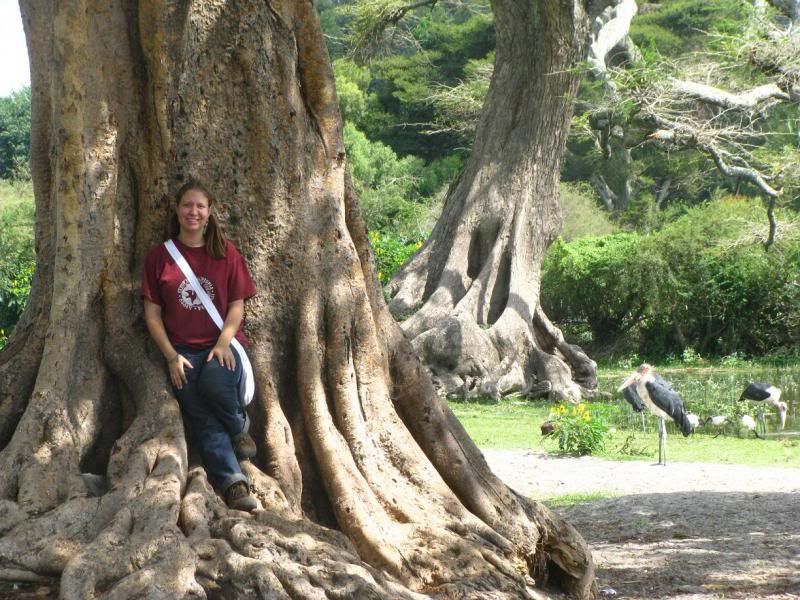
A weird-looking stork in front of Lake Hawassa!

Giant stork by Lake Hawassa photo 18208_10101622206117838_665818569_n.jpg

The deadliest animals in Africa, not ten feet away from our boat in Hawassa.

Hippos!!! photo 604049_10101622209022018_887424722_n.jpg

Locals frying and selling freshly caught tilapia near Lake Hawassa.

Fish sellers by Lake Hawassa.  Tilapia, to be specific.  Tasty tilapia to be even more specific. photo 533970_10101622206631808_1414976932_n.jpg